
Noise from data centres is making headlines across Australia. Communities are anxious about potential noise impacts of planned data centres, and emerging noise complaints from operational data centres are adding to negative perceptions.
Governments and regulators are reacting quickly with a wave of action plans, guidelines and inquiries. The Commonwealth has issued a consultation paper, Victoria has proposed an action plan and EPA technical information requirements, while NSW has held a parliamentary inquiry and published data centre guidelines. Some of these include technical assessment guidance, but none set a noise limit tailored to data centres.A seemingly obscure and technical detail of the procedure for measuring compliance with the industry noise requirements of the Environment Protection Regulations 2021 (EP Regulations) has significant implications for new residential development in mixed use areas.
Noise is still managed through state policies
Data centre noise is assessed under each state's general industrial noise policy. Assessment requirements differ from state to state, but the policies are variations on common themes. They generally require consideration of:
noise limits for different times of the day based on zoning, background noise or both
adjustments for annoying character, such as tones
low-frequency noise
cumulative noise from more than one site.
What counts as an emergency?
Not all government policy makes it clear whether the uninterrupted operation of data centres is regarded as being as important as other essential infrastructure such as energy and water supply, transport and health care. Hyperscale data centres can have a hundred or more standby diesel generators, and they generally run in three different situations:
Testing: routine runs of one or a few sets, often allowed at relaxed limits or within set hours.
Load sharing or grid support: running for market or network reasons, which most policies do not address.
Emergency: a genuine grid outage, when every set runs at once.
Each jurisdiction defines an emergency differently and applies different noise assessment methods in each situation. Some exempt assessment in a genuine power outage and some cap generator hours, while others do not address emergency scenarios at all. In some cases, such as for a large project in WA, emergency generator use was assessed against the standard night period noise limits which was a contributing factor to the project not proceeding. The same design can therefore be acceptable in one state but refused in another.
The challenge is scale
The plant itself is mostly well established, and noise data is usually available from manufacturers.
The emerging challenge is addressing the sheer number of chillers and generators.
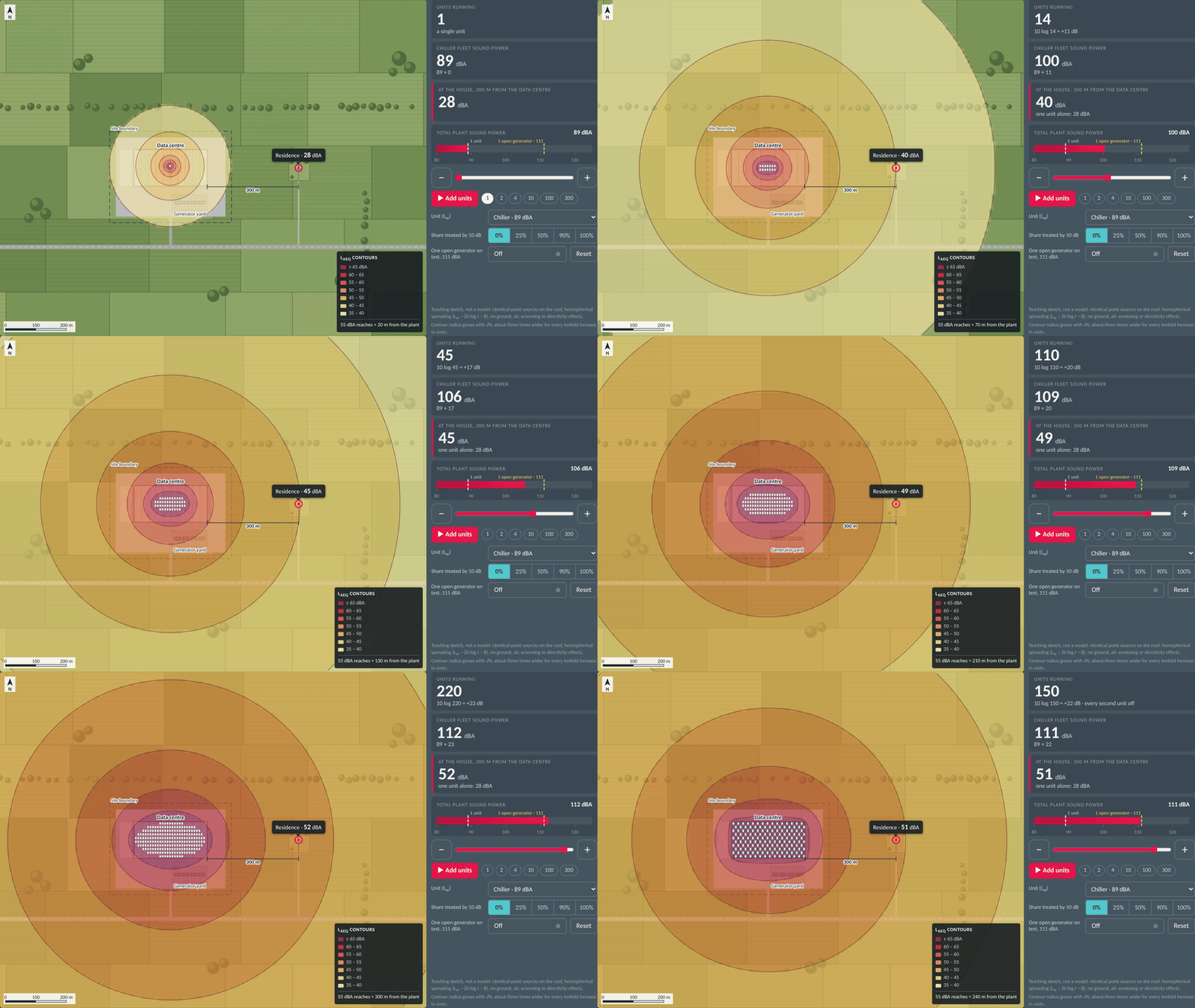
When we add noise sources, it’s done logarithmically (10 x logN, where N is the number of units).
Two units are 3 dB louder than one, ten are 10 dB louder and a hundred are 20 dB louder. The first ten units add 10 dB of noise, and the next ninety only add another 10 dB.
The same logic works in reverse. Halving the fleet may only save 3 dB. So, once you get to large numbers, even fairly radical reductions don’t necessarily work as noise control.
Key noise sources
The two main data centre noise sources are cooling plant and standby generators.
| Air-cooled chillers | Water-cooled chillers and cooling towers | |
|---|---|---|
| Water use | Minimal | High, through evaporation |
| Power use | Higher, worse on hot days | Lower and steadier |
| Noise | Louder, with fans outdoors | Quieter, with chillers indoors |
Australia seems to be predominantly moving towards air-cooled plant to save water, which puts more fans outdoors and compounds noise challenges. Air-cooled chillers can still be treated, but this will require greater engineering input and will increase construction costs.
Generators are the other major source, and these will almost certainly need to be packaged units with notable noise reduction features.
Sites also have pumps, transformers, load banks and often co-located battery energy, which all need to comply with the noise limit.
Location, location, location
There are proven engineering controls for all these sources: quieter equipment selections, acoustic enclosures, attenuators, louvres and plant rooms.
Given the scale of the projects, treating all these sources with physical controls can be expensive and require notable design input and balancing of factors.
Strategic siting and orientation can be key to acoustic feasibility. Distance from homes, using buildings to screen plant, and pointing discharges and exhausts away from neighbours can notably reduce the treatment needed.
Barriers may not work
Noise barriers need to be close to the noise source or receiver to provide a material effect. Their effectiveness can be limited for data centres due to:
Arrays of plant. A barrier screens noise from the nearest units, but units further back don’t ‘see’ it and get the same benefit.
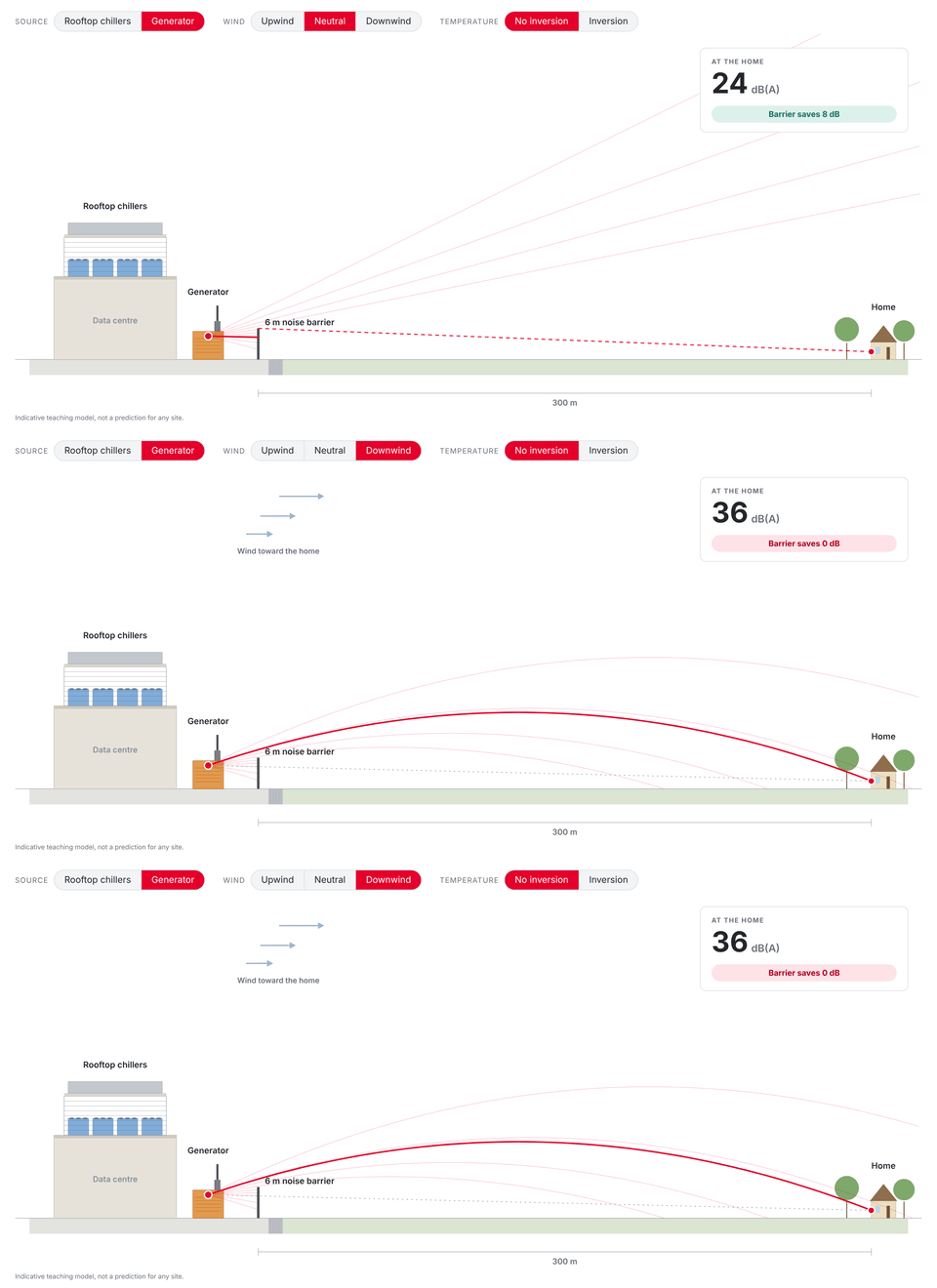
Curved sound paths. Wind blowing towards homes, or a night-time temperature inversion, bends sound down over the barrier and removes much of its effect.
The example below demonstrates the change in barrier effect between neutral and downwind conditions.
Sharing the limit
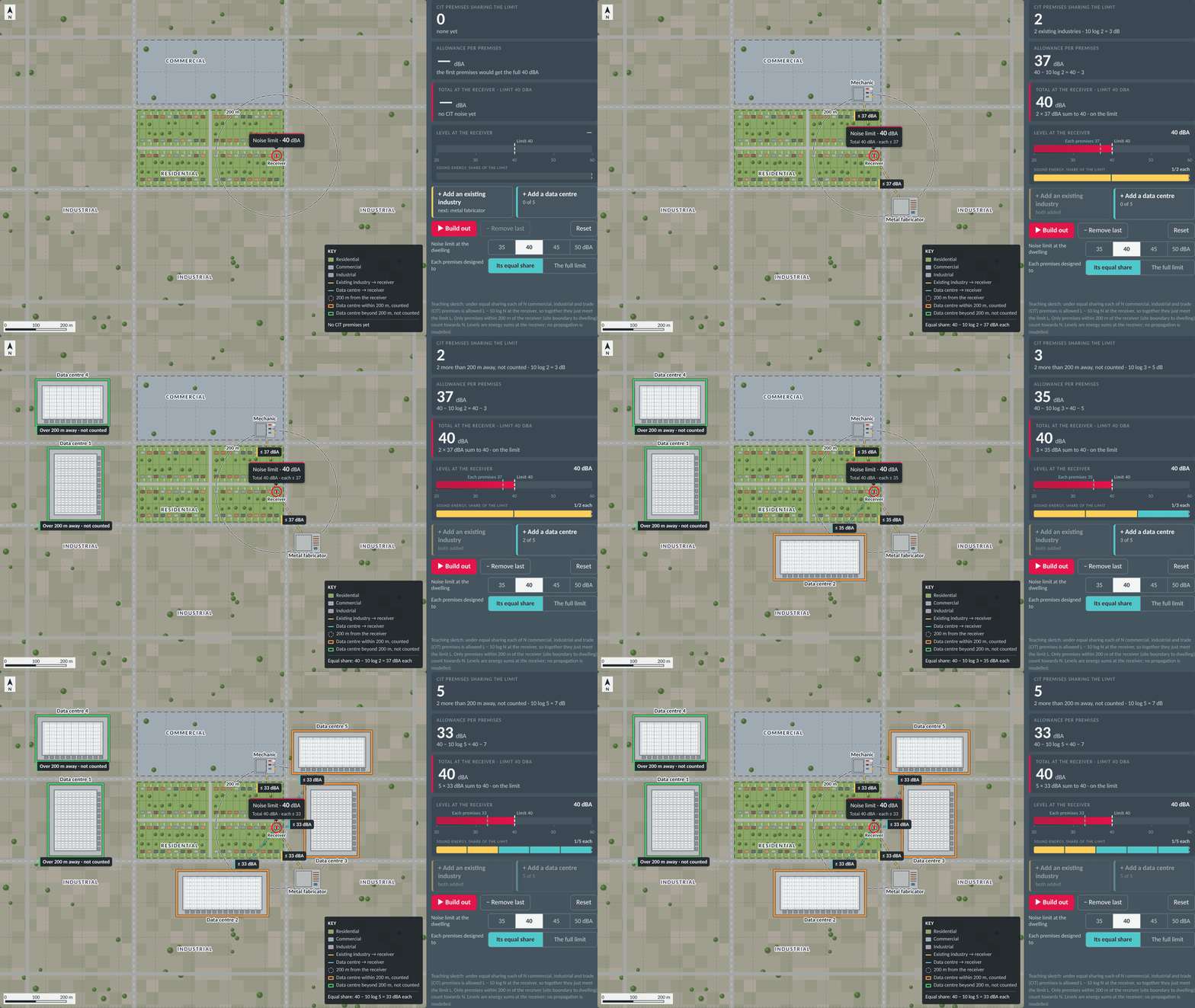
Most jurisdictions require consideration of cumulative noise or background creep. Where several premises affect the same receivers, the noise limit may need to be shared between the noise generating uses. A new data centre might have to design to a lower limit to leave room for further noise from existing industry, or for other planned projects nearby. This is another nod to early consideration of acoustics when assessing site feasibility.
As an example, Victorian noise assessment adopts an equal sharing principle. The method uses the same 10 x logN principle discussed above, but in this case N is the number of premises, and the result is subtracted from the total noise limit to determine each premises’ individual noise target. The idea being that when summed, if all premises achieve their target, the total limit is achieved.
With five premises sharing a 40 dB limit, each premises would need to contribute less than 33 dB each to achieve the 40 dB overall limit.
Compliance versus impact
There is a risk in only considering pure noise limit compliance when assessing noise from data centres, because we haven’t yet seen a project put through the formal impact, risk or significance frameworks used for major projects.
If that lens were applied, several contextual factors could raise the risk rating for a compliant design:
noise from cooling plant is constant, with little to no respite
noise is often most apparent at night, particularly on hot nights with windows open
tonal and low-frequency character is more annoying
communities may hold preconceived concerns, given the headlines and limited understanding of the growing industry
generator scenarios carry real uncertainty about how often and how many may operate.
Data centres can work acoustically
Noise can make or break a project, or add large, late costs if left until the design stage. Engaging acoustic input at the site feasibility stage will result in greater understanding, less uncertainty and better foresight of risks for the project.
We presented on this topic at the EIANZ 2026 Annual Conference in Melbourne. If you are planning a data centre, give us a call to talk it through.
Authors

Travis Hancock

Lachlan Deen
